
How to Identify the 1805 Draped Bust Quarter
A Draped Bust, Heraldic Eagle quarter from the second year quarters were struck with this design, more available today than the 1804 date but still an early scarce type coin.
Read the full 1805 Draped Bust Quarter encyclopedia entry →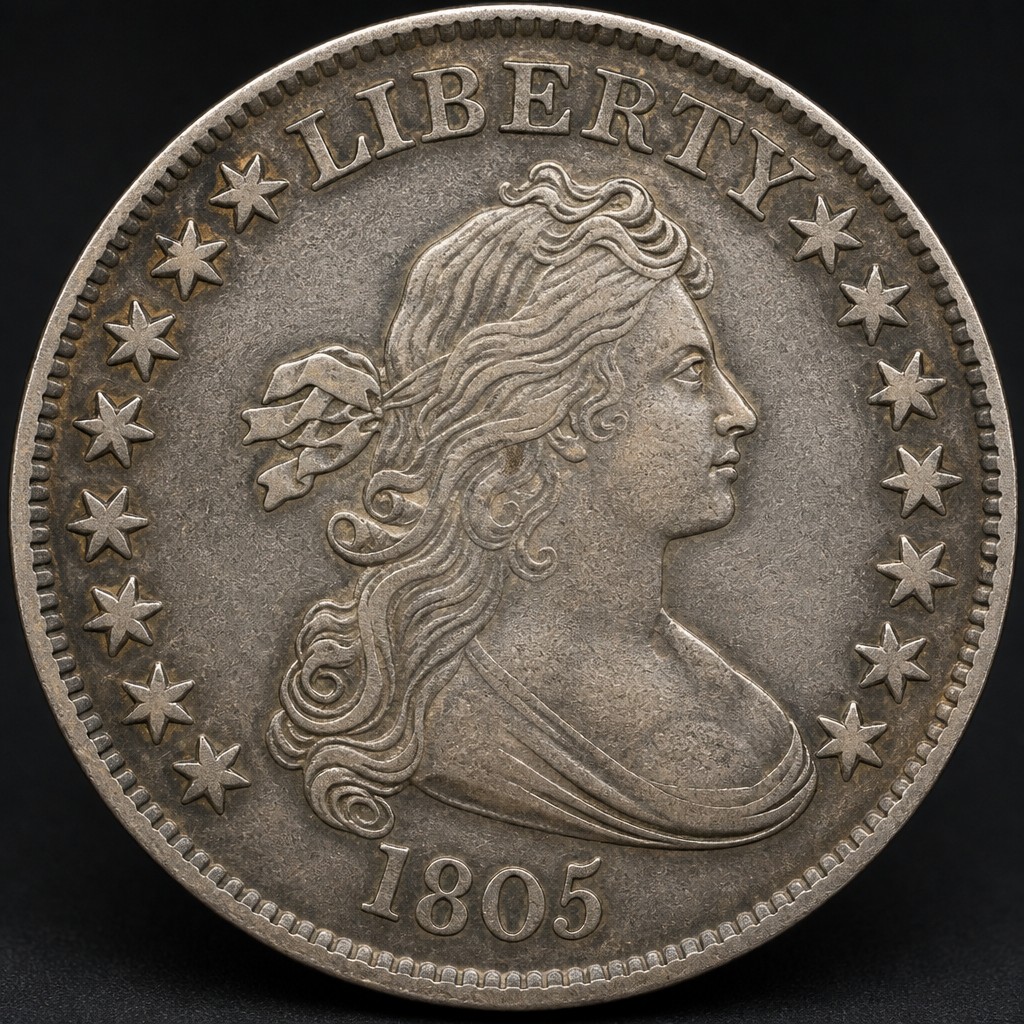
What the Coin Is
The 1805 quarter is part of the Draped Bust, Heraldic Eagle series struck in the early 1800s. It shares its design with the 1804, 1806, and 1807 quarters, differing only in date, and was produced in somewhat larger numbers than the 1804 issue, making it a somewhat more attainable entry point into this early type for collectors.
Obverse Design & Inscriptions
Liberty appears in profile facing right as a draped bust, her hair bound with a ribbon reading "LIBERTY" above her head. Stars surround the portrait — typically seven to the left and six to the right — with the date "1805" centered below the bust, and drapery folds cover her shoulder in the same manner used across this entire design type.
Reverse Design & Inscriptions
The reverse carries a heraldic eagle with a shield on its breast, an olive branch and arrows in its talons, and a ribbon in its beak inscribed "E PLURIBUS UNUM." The legend "UNITED STATES OF AMERICA" runs around the rim, with no numeral denomination shown, consistent with other early quarters that relied on size and design alone to signal their value.
Size, Weight, Metal, Edge
This is a silver coin weighing approximately 6.74 grams with a diameter near 27.5 mm, using the early Mint's silver-copper alloy. The edge is reeded, and the overall heft of the coin in hand should feel notably larger and heavier than a modern clad quarter.
Mint Marks
No mintmark is present; the coin was struck solely at the Philadelphia Mint, which did not use mintmarks at this time, a pattern that holds true for all early U.S. quarter dollar issues of this design.
Telling It Apart From Similar Coins
Since the design is identical across 1804-1807, careful reading of the date is essential. On the 1805, note that the final "5" has a distinctive curved tail; compare against reference images to avoid confusing a worn "5" with a "3" or "8" style digit from other early series coins, especially on well-circulated examples where fine details have softened.
Judging Condition at a Glance
Check the high points first: Liberty's bust and hair curls, the stars' centers, and the eagle's wing and shield details. Because striking quality varied on early Mint presses, some areas may show natural planchet weakness rather than actual wear — compare high and low points together before estimating a grade, since a weakly struck but lightly circulated coin can otherwise be mistaken for a heavily worn one.
Authenticity Red Flags
Examine the date for uneven spacing, a mismatched digit style, or a slightly different alignment that would suggest an altered date from a more common early quarter. Also check the coin's edge and surface texture — a cast counterfeit often has soft, rounded details, tiny surface bubbles, and a seam that a genuinely struck coin will not show, and its overall diameter or weight may also fall slightly outside expected tolerances.
Frequently asked questions
What separates the 1805 quarter from the 1804?
Both share the identical Draped Bust, Heraldic Eagle design; the date is the only visual distinction, so verifying the numerals is critical.
Was the 1805 quarter struck anywhere besides Philadelphia?
No, all quarters of this era came only from the Philadelphia Mint, and no mintmarks were used.
What should I check before assuming a low grade?
Compare high-point wear against natural striking weakness, which was common on early Mint presses and can look similar to wear at first glance.
How do I spot a counterfeit of this type?
Look for soft or mushy design details, surface pitting, and edge seams, all signs of a cast rather than struck coin.