
How to Identify the 1804 Draped Bust Quarter
The first quarter dollar of its type struck in very small numbers, featuring Liberty's draped bust on the obverse and a heraldic eagle on the reverse.
Read the full 1804 Draped Bust Quarter encyclopedia entry →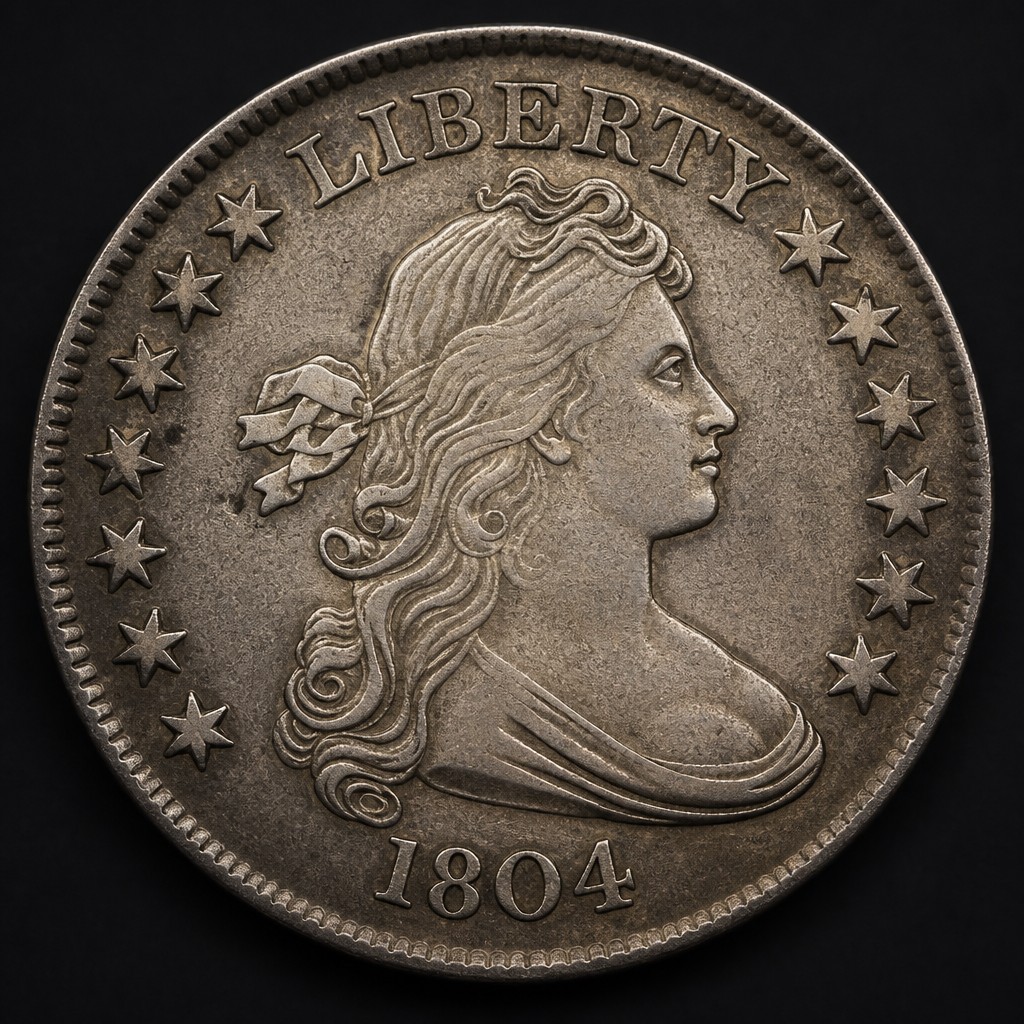
What the Coin Is
The 1804 quarter belongs to the Draped Bust, Heraldic Eagle type, one of the earliest quarter dollar designs struck by the United States Mint. Quarters of this era were produced in modest numbers and were not made every year, so a genuine 1804 example is a scarce survivor of early American coinage, coming from a period when the Mint's presses and dies were far less consistent than modern equipment.
Obverse Design & Inscriptions
The obverse depicts Liberty as a draped female bust facing right, her hair tied with a ribbon, surrounded by stars (arranged unevenly around the border) and the date "1804" below. The word "LIBERTY" appears on a ribbon or band across her hair, and the overall portrait style follows the same Draped Bust motif used on other early U.S. silver denominations of the period.
Reverse Design & Inscriptions
The reverse shows a heraldic eagle with wings spread, holding an olive branch in one talon and arrows in the other, a shield on its breast, and a ribbon in its beak reading "E PLURIBUS UNUM." The legend "UNITED STATES OF AMERICA" wraps around the border; there is no stated denomination on the reverse, which is typical for this early type and can surprise collectors used to later coins that spell out their value.
Size, Weight, Metal, Edge
The coin is struck in 89.24% silver (approximate early Mint standard), weighs roughly 6.74 grams, and measures about 27.5 mm in diameter. The edge is reeded, applied before striking on early Mint equipment, and the reeding on genuine examples tends to look slightly less uniform than on later, more mechanically refined coinage.
Mint Marks
No mintmark appears anywhere on this coin. All quarters from this era were struck exclusively at the Philadelphia Mint, which did not use a mintmark on its coinage at the time, so there is no need to search the surfaces for a mint identifier.
Telling It Apart From Similar Coins
The 1804 is easily confused at a glance with other Draped Bust, Heraldic Eagle quarters from 1804 through 1807, since the overall design is identical across those years — the date is the only reliable way to separate them. Be sure the numerals read clearly as "1804" and not a worn or altered "1806" or "1807," which share similar digit shapes when worn, and take time comparing the spacing between digits against known genuine examples.
Judging Condition at a Glance
Because these coins circulated heavily and were struck with imperfect early dies, look for weakness of strike on Liberty's hair curls and the eagle's shield lines even on lightly worn coins. Even well-worn examples with a clear date and visible major design elements are considered desirable due to the coin's overall scarcity, so condition expectations should be adjusted accordingly compared with more modern coinage.
Authenticity Red Flags
Given the coin's age and scarcity, altered dates are a real concern — examine the "4" in "1804" closely for signs of re-engraving, unnatural spacing, or a mismatched font compared to reference photos of the type. Cast copies often show a grainy or pitted surface, a seam around the edge, and softer, mushy details compared to a genuinely struck coin, and their weight can also fall noticeably outside the expected range for a genuine piece.
Frequently asked questions
How can I tell an 1804 quarter from other early Draped Bust dates?
The overall design is shared across several years, so the date itself is the key differentiator — check the numerals carefully for wear or tampering.
Does the 1804 quarter have a mintmark?
No, it was struck only at Philadelphia, which did not place mintmarks on coins during this period.
What metal is it made of?
It is a silver coin using the early U.S. Mint's silver alloy standard, with a reeded edge.
What's the biggest authenticity concern with this coin?
Altered or re-engraved dates and cast counterfeits are the primary concerns given the coin's age and scarcity.