
How to Identify the 1802 Draped Bust Half Dime
A guide to the 1802 Draped Bust half dime's Heraldic Eagle reverse, its status as one of the great rarities of early U.S. coinage, and key date-authenticity checks.
Read the full 1802 Draped Bust Half Dime encyclopedia entry →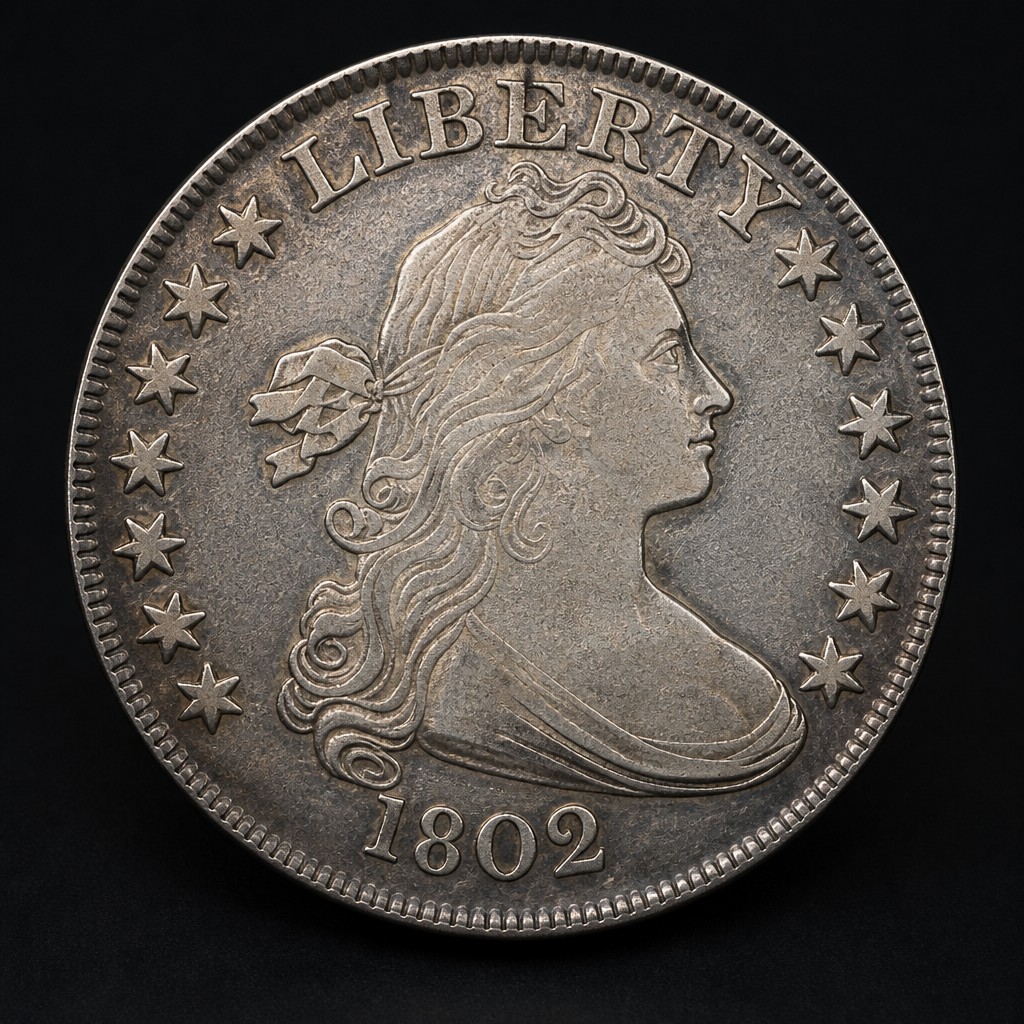
What It Is
The 1802 half dime carries the Draped Bust obverse paired with the newer Heraldic Eagle reverse, a design based on the Great Seal of the United States that replaced the earlier small eagle beginning around 1800. It is one of the lowest-mintage, most sought-after dates in the entire half dime series, and it is often cited alongside other early American rarities as one of the coins every advanced collector hopes to see in hand at least once.
Obverse Design
Liberty faces right with tied hair and draped shoulders, LIBERTY above, the date below, and by this date the star count is standardized at 13, split seven and six on either side of the bust. This settled star arrangement is typical of Draped Bust coinage struck after 1800, once the Mint stopped adding a star for each new state.
Reverse Design
The reverse shows a Heraldic Eagle with a shield on its breast, holding an olive branch in one talon and arrows in the other, a banner above inscribed E PLURIBUS UNUM, and clouds with small stars above the eagle's head. UNITED STATES OF AMERICA circles the border. No numeral denomination is present, consistent with all half dimes struck before the 1830s.
Size, Weight, Metal, and Edge
The coin measures about 16.5mm across and weighs approximately 1.35 grams in the standard silver-copper alloy of the period, with a plain reeded edge and no edge lettering.
Mint Marks
No mint mark appears; the Philadelphia Mint produced all half dimes at this time, since it remained the only operating U.S. mint.
Telling It Apart From Similar Coins
The Heraldic Eagle reverse distinguishes 1802 and later Draped Bust half dimes from the small eagle reverse used through 1797. Because 1802 is scarce with an original mintage of only a few thousand pieces, genuine examples are identified through comparison of die characteristics (star spacing, digit placement, and known die marriage references) rather than gross design alone. Collectors also compare the specific positioning of the date relative to the bust, since genuine dies have a consistent, well-documented layout.
Judging Condition at a Glance
Look at the drapery lines at Liberty's bust, the hair above her ear, and the eagle's shield and wing feathers for early wear. Because so few originals survive, most known examples fall in heavily circulated grades, and even modest, problem-free coins are considered desirable; sharp, well-centered strikes with full rims are especially prized regardless of the overall wear level.
Authenticity Red Flags
The 1802 half dime's rarity makes it one of the most frequently altered dates in the series, typically by adding or reshaping a digit on a more common date to mimic an 1802. Examine the last digit of the date under magnification for tool marks, doubling, or an unnatural surface texture that differs from the rest of the coin. Compare the digit spacing and overall look to published die diagrams for this date, and treat any example without a clear pedigree or certification from a major grading service with caution.
Frequently asked questions
What makes the 1802 half dime rare?
It had a very low original mintage of only a few thousand pieces, making it one of the scarcest dates in the entire half dime series.
How is the 1802 reverse different from earlier half dimes?
It uses the Heraldic Eagle design, with a shield-bearing eagle and a banner reading E PLURIBUS UNUM, replacing the small perched eagle used on 1794-1797 issues.
Why are 1802 half dimes often suspected of being altered?
Because genuine examples are extremely valuable, some forgers alter the last digit of a more common date to imitate an 1802; the date should be examined closely for tooling marks.
Does the 1802 half dime have a mint mark?
No, all half dimes of this era were struck at the Philadelphia Mint without a mint mark.