
How to Identify the 1793 Chain Cent
A visual guide to the 1793 Chain Cent, America's first circulating cent, covering its AMERI. versus AMERICA reverse varieties, edge types, and the key features collectors use to attribute this historic rarity.
Read the full 1793 Chain Cent encyclopedia entry →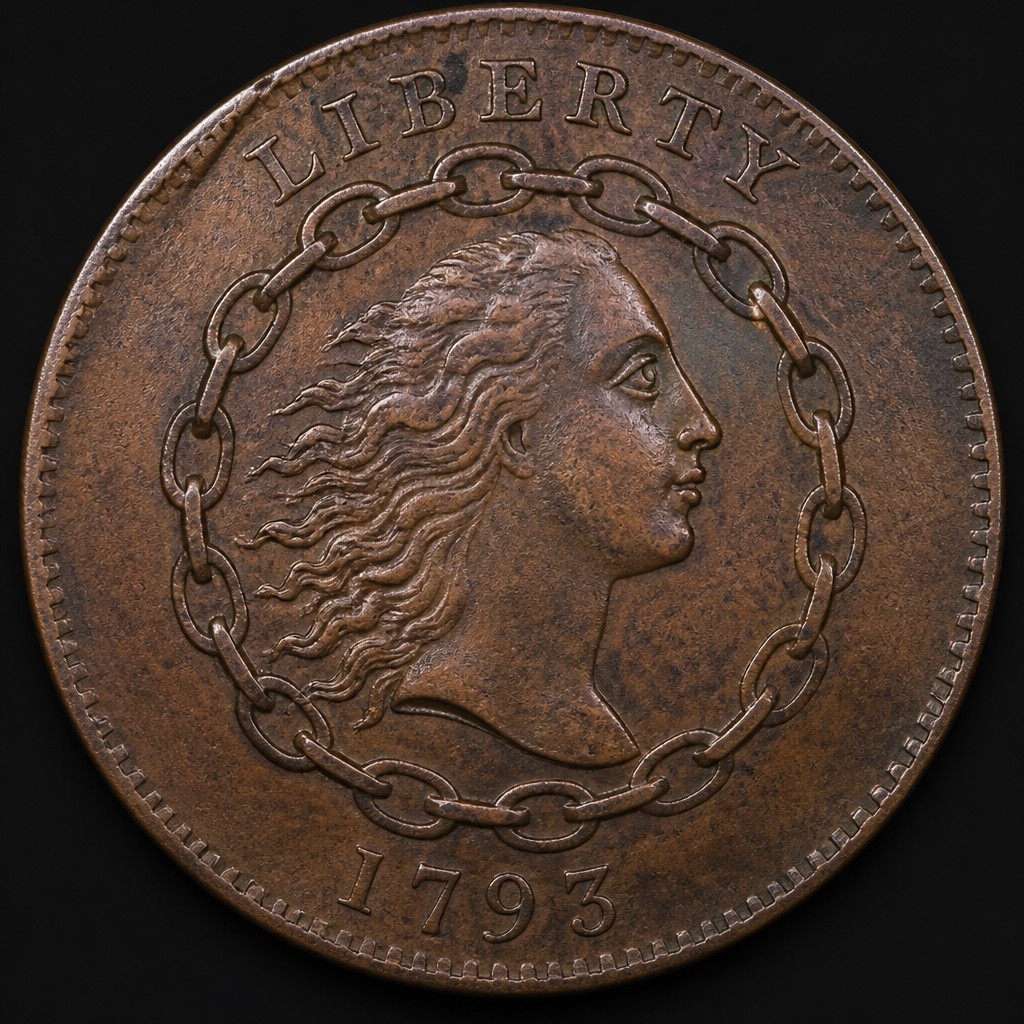
What It Is
The 1793 Chain Cent holds the distinction of being the very first cent struck for circulation under the newly organized United States Mint. It was produced only briefly before the chain reverse was replaced, making genuine examples both historically important and scarce.
Obverse Design
Liberty faces right with loose, flowing hair, LIBERTY above, and 1793 below. The engraving has a somewhat rough, hand-cut appearance typical of the Mint's very first dies, and Liberty's expression is sometimes described by collectors as unusually severe compared to later portraits.
Reverse Design
A chain of interlocking links, usually counted as fifteen to represent the states, surrounds ONE CENT and the fraction 1/100. Collectors recognize two major legend varieties on the reverse border: one reading AMERI. with a period, an abbreviation used on the earliest dies, and a revised version spelling out AMERICA in full. The AMERI. variety is generally considered the rarer and more sought-after of the two.
Size, Weight, Metal, and Edge
The coin is struck in pure copper at the earlier, heavier 1793 weight standard, generally around 208 grains (about 13.48 grams), with a diameter in the high 20s of millimeters that can vary somewhat due to hand striking. Edge treatments differ by variety, including a lettered edge referencing the coin's value relative to a dollar.
Mint Marks
There is no mint mark on this coin, as it was struck solely at the original Philadelphia Mint.
Telling It Apart From Similar Coins
The chain-link reverse is unique to this exact coin among all U.S. cents; no other year or type uses this motif, making misidentification unlikely once the reverse is examined. Within the type itself, careful comparison of the reverse lettering separates the AMERI. and AMERICA varieties, and subtle differences in the obverse hair and lettering style are used by specialists to attribute individual die marriages.
Judging Condition
Because surviving examples are scarce and often well used or environmentally affected after more than two centuries, grading focuses on the legibility of LIBERTY, the definition of the chain links, and the overall smoothness or roughness of the surfaces. Even well-worn examples remain desirable to collectors given the coin's historical status.
Authenticity Notes
As one of the most iconic and valuable early American coins, the 1793 Chain Cent has attracted counterfeiters for well over a century, including cast reproductions and coins with added or recut dates. Signs to look for include a surface that appears cast rather than struck, a visible seam around the edge, incorrect diameter or weight compared to documented genuine ranges, and lettering or portrait details that do not match the known die varieties for this issue.
Frequently asked questions
What makes the 1793 Chain Cent historically significant?
It was the first cent struck for circulation by the United States Mint.
What is the difference between the AMERI. and AMERICA varieties?
AMERI. uses an abbreviated reverse legend from the earliest dies, while AMERICA spells the word out in full on slightly later dies; AMERI. is generally rarer.
Does the 1793 Chain Cent have a mint mark?
No, it was struck only at the original Philadelphia Mint and has no mint mark.
Why was the Chain Cent design discontinued so quickly?
The public objected to the chain-link reverse as evoking slavery or bondage rather than unity, prompting a quick redesign to a wreath reverse.