
How to Identify the 10 Markka
A quick collector's guide to spotting Finland's bimetallic 10 markkaa: the capercaillie bird, the two-tone metal, size and legends.
Read the full 10 Markka encyclopedia entry →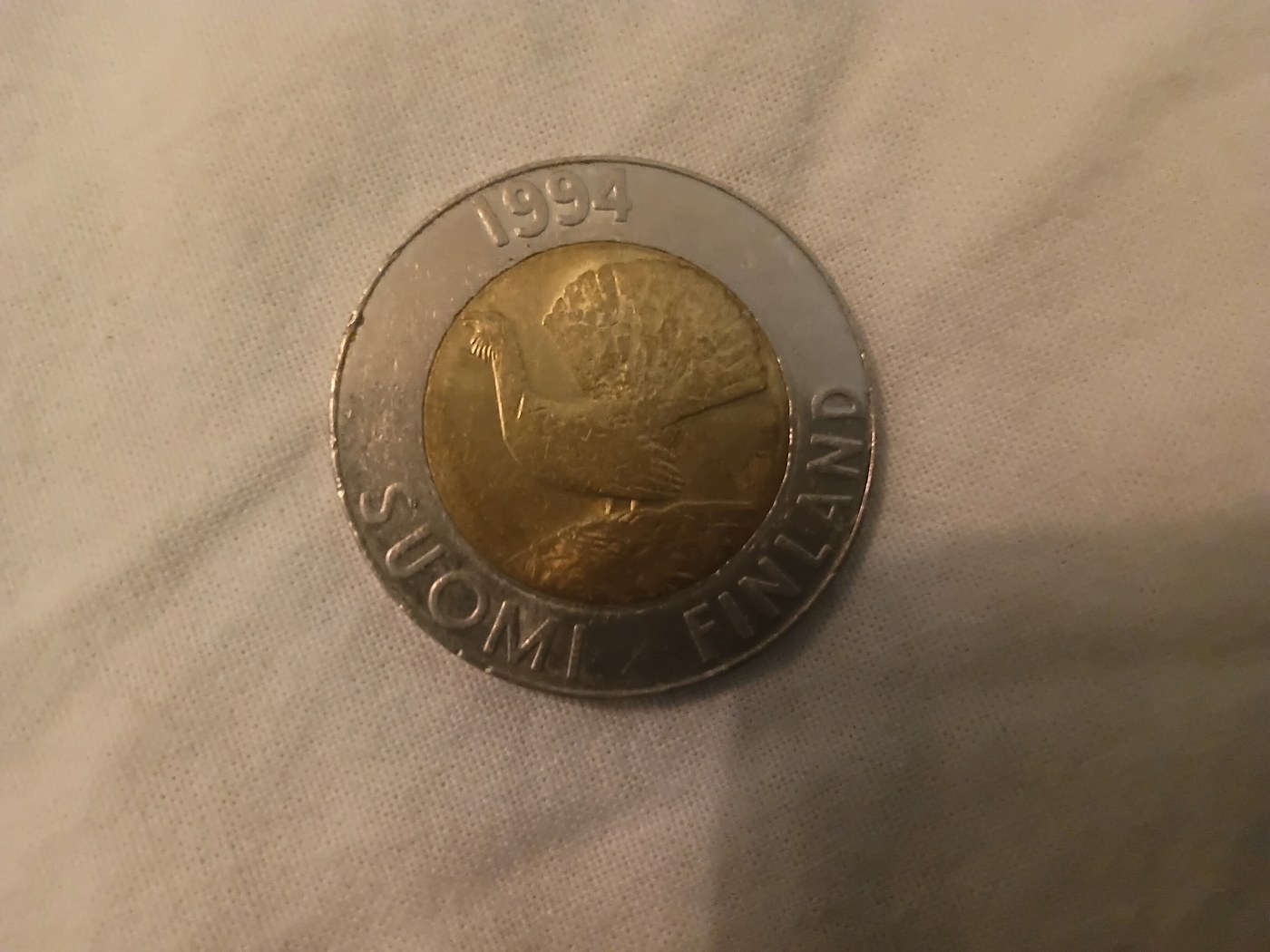
Start with the overall look. The modern Finnish 10 markkaa is unmistakably bimetallic: a light, silvery cupronickel ring wrapped around a warm gold-coloured aluminium-bronze centre. If your coin is a single solid colour, it is not this type. The diameter is about 27 mm, it weighs roughly 8.8 g, is about 2 mm thick, and has a plain (smooth) edge.
Check the design on each face. The capercaillie side (shown on the 1994 example) has a large, fan-tailed forest grouse filling the golden centre, with the four-digit year curving above and the words SUOMI FINLAND around the outer ring. The other face shows a big numeral 10 with the word MARKKAA and a rowan-branch ornament — that value side is how you confirm the denomination rather than mistaking it for a lower coin.
Use the legends and date to pin down the type. SUOMI FINLAND identifies the country, and the year (1993 through 2001) identifies the issue within this final markka series. Because there is only one modern bimetallic 10 markkaa design, matching the bird, the two-tone metal, and a date in that range is usually enough for a confident identification.
Watch for look-alikes. Finland's 1 markka and 5 markka coins from the same era are smaller and, importantly, single-metal, so the bimetallic construction alone rules them out. Much older pre-1963 Finnish 10 markkaa coins exist but are one solid metal and bear early 20th-century dates. There is little incentive to counterfeit a low-value modern coin, so authentication is rarely a concern; instead, judge condition and originality — look for sharp feather detail, an unblemished ring/core boundary, and no signs the two metals have loosened.
Frequently asked questions
How do I tell the 10 markkaa from the 1 and 5 markka coins?
The 10 markkaa is the only one that is bimetallic (a pale ring around a gold centre) and it shows the numeral 10 with the word MARKKAA on the value side. The 1 and 5 markka coins are single-metal and smaller.
Which side is the obverse?
Catalogues treat the capercaillie-and-legend side (with the year and SUOMI FINLAND) as the obverse and the large numeral 10 with rowan branch as the reverse, though collectors often refer to them simply as the bird side and the value side.
How can I check that a coin is genuine?
Confirm the specifications — about 27 mm across, roughly 8.8 g, plain edge, and a firmly seated two-metal construction — and look for crisp capercaillie detail. Given its low value, fakes are uncommon, so grading condition matters more than authentication.